You likely have a clear view of how your team is performing.
What is often less visible is the condition of the leadership system behind that performance.
Executive teams can deliver strong results while subtle dynamics begin to erode alignment, candor, and decision quality. Performance metrics rarely reveal early signals such as withholding feedback, unspoken tension, or uneven leadership load.
The question is not simply whether your team is performing. It is whether the leadership environment supporting that performance is sustainable.
What Is Team Health—and Why Does It Matter?
Team health reflects the underlying dynamics shaping how leaders communicate, challenge each other, and make decisions together.
When those dynamics are strong, leadership teams move with clarity and trust. Difficult conversations happen earlier. Decisions improve. Pressure is shared rather than concentrated.
When health weakens, even capable teams can drift toward silent misalignment, decision fatigue, and unnecessary friction.
Results may continue for a time. But the leadership architecture beneath them becomes increasingly fragile.
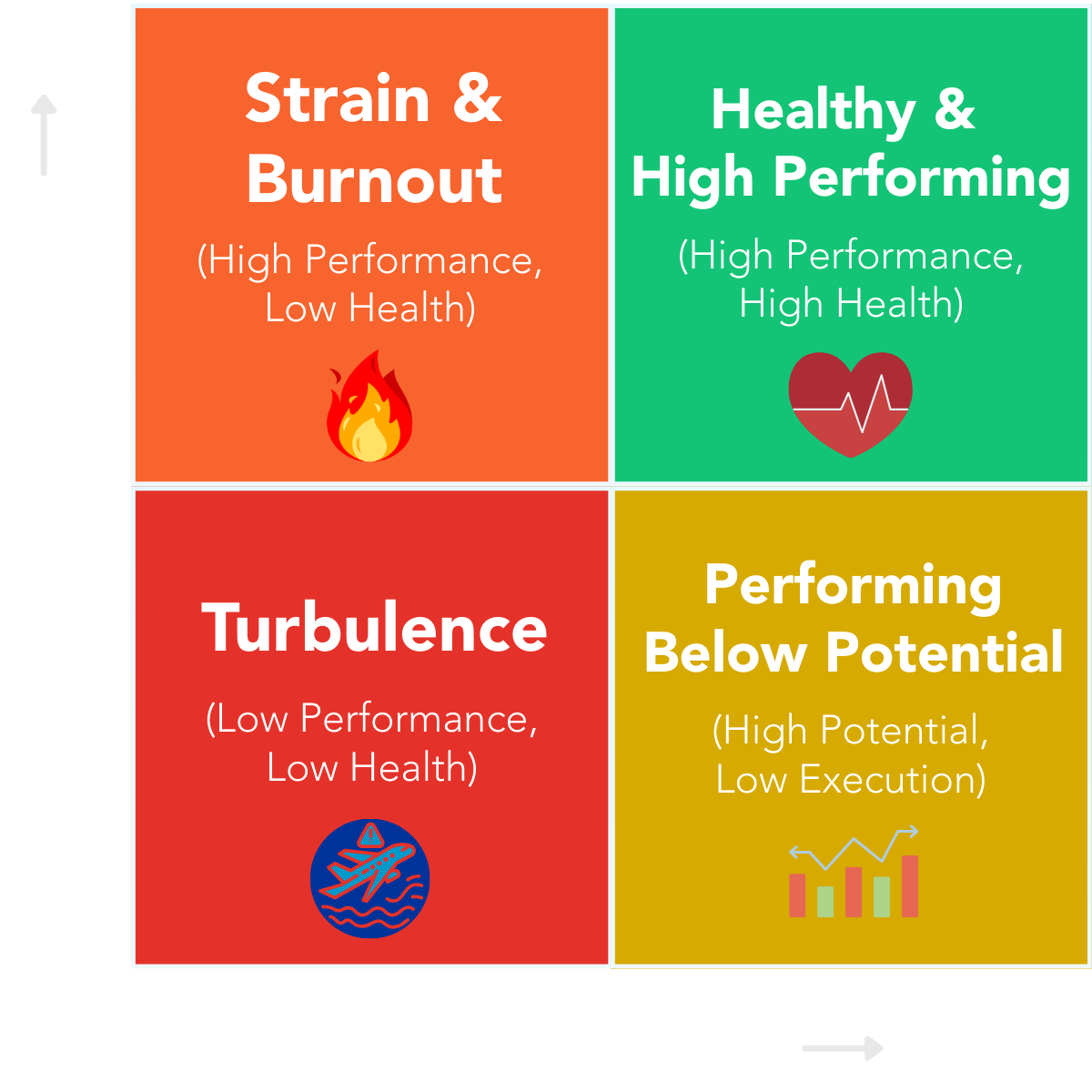
Where Does Your Team Sit Right Now?
This diagnostic places executive teams across two dimensions: performance and health. Together, they reveal four common operating zones.
Healthy & High Performing (High Performance | High Health)
Leadership conversations are candid and disciplined. Authority is clear but not isolating. Pressure is shared and decision-making remains strong even under stress.
Strain & Burnout (High Performance | Low Health)
Results remain strong, but underlying strain is building. Leaders may be carrying disproportionate emotional weight, avoiding difficult conversations, or relying on unsustainable effort. Performance can conceal the early signals of erosion.
Performing Below Potential (High Capability | Low Execution)
Talent and experience are present, but leadership energy is diffused. Misalignment, unclear priorities, or inconsistent communication prevent the team from operating at its full capacity.
Turbulence (Low Performance | Low Health)
Trust has weakened and clarity is inconsistent. Decision processes stall or fragment, and leadership attention is consumed by internal friction rather than forward movement. This zone signals the need for deliberate recalibration.
Why This Matters to Leaders
Many executive teams appear stable on the surface because goals are being met. What remains unseen are the underlying dynamics shaping how leadership operates together.
Understanding your team’s current zone can help you:
• Detect early signs of silent misalignment
• Strengthen candor and decision quality at the executive table
• Address hidden dynamics before they erode trust
• Build a leadership environment capable of sustaining performance under pressure
What to expect with the diagnostic
Your “team” refers to the leadership group you work with most closely. This may be your executive team, a senior functional leadership group, or the core leadership circle of a smaller organization.
Answer ten brief questions to identify your team’s current zone.
You will receive insight into how your leadership dynamics are functioning today and where recalibration may strengthen performance and trust.
Gain a clearer view of the leadership environment shaping your team’s performance.